Direct Media Extraction from Voice Logging Systems
Jan 13, 2026
ComplianceMigrationVoice Data
Overview
When large volumes of call recordings are locked away in aging or proprietary voice logging systems, organizations face a difficult mix of technical risk, operational disruption, and tight project timelines. Traditional extraction methods are often slow, manual, and constrained by legacy hardware and software, making them poorly suited for bulk migrations or regulatory retention projects.
This guide introduces the XOVOX 10-step direct extraction process, a structured approach for retrieving audio and metadata directly from underlying storage media instead of relying on the original recorder interfaces. By combining modern infrastructure, format-aware processing, and rigorous reconciliation, the process is designed to handle millions of recordings efficiently while preserving evidential integrity and auditability.
The following sections explain the main extraction options available, outline why direct media extraction is recommended for large-scale projects, and walk through each of the 10 steps from initial inventory to final delivery of import-ready files. The goal is to give project teams a clear, repeatable roadmap they can use to plan, execute, and validate complex voice recorder data migrations with confidence.
Four Main Extraction Methods
1. Original Logger Equipment
How it works: Use the original recording system’s built-in playback features
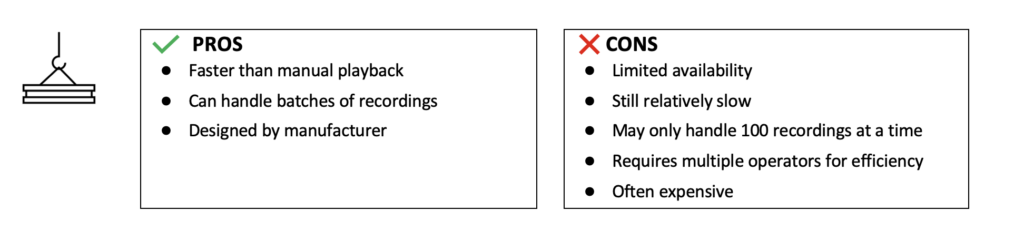
2. Bulk Retrieval Tools
How it works: Use manufacturer-provided software for batch download
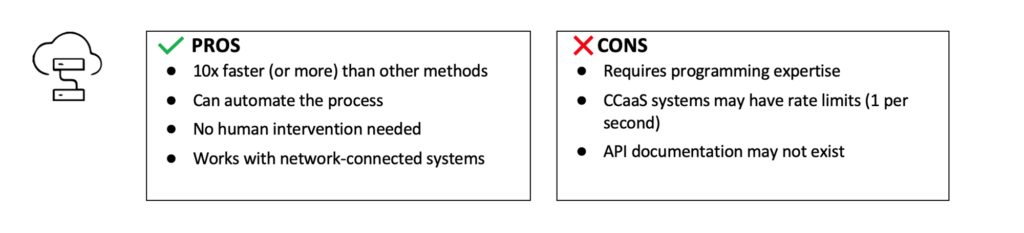
3. Custom API Tools
How it works: Write custom software to communicate with the logging system
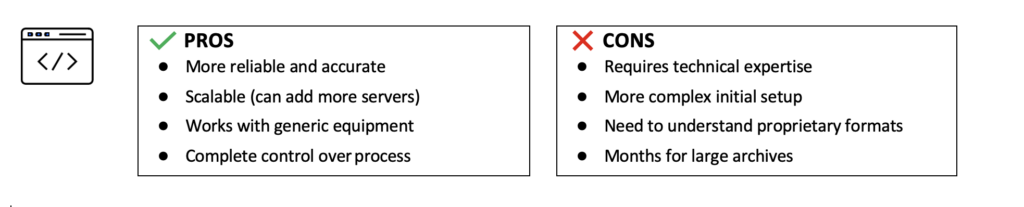
4. Direct Media Extraction ⭐ Recommended
How it works: Extract audio files directly from storage media without using original equipment or original software
The XOVOX 10-Step Direct Extraction Process
XOVOX has productized Method #4, the direct media extraction approach. Through two decades of performing these projects across hundreds of organizations, we’ve refined and optimized the tools and process to its current form. The following 10-step guide provides a structured and tested approach that XOVOX uses for successfully executing voice recorder data extraction at any scale.
Deploy Computing Environment: Set up Linux servers (physical or virtual). Configure secure access (VPN). Install fast disk storage.
Inventory the Archive: List all stored files, tapes, or DVDs. Export database tables if available. Document the full scope of data.
Fetch Source Data: Copy all archive files locally. Create byte-for-byte images of tapes/DVDs. Identify any damaged or blank media.
Extract Basic Metadata: Pull information embedded in raw data. Create individual call records. Gather timestamps, channel numbers, etc.
Convert Audio Formats: Transcode from nonstandard compression algorithms. Convert to open file formats (like WAV). Ensure compatibility with target systems.
Extract Extended Metadata: Pull additional information from databases. Match metadata to audio files. Include agent names, phone numbers, etc.
Format Metadata: Convert to required formats (CSV, XML, JSON). Prepare for import into target system.
Reconcile and Verify: Confirm all recordings were extracted. Account for any missing files. Document exceptions and reasons.
Deliver Final Results: Transfer to target location. Verify successful delivery. Provide import-ready files.
Special Considerations
In addition to the core 10 steps, there are several special considerations that can significantly affect planning, timelines, and execution strategy for complex or active environments.
Active Systems
For systems still in use:
Extract 95% of historical data first
Perform final 5% extraction after shutdown
Or set up daily/hourly extraction for ongoing operations
Large-Scale Projects
Steps can be performed in parallel
Additional servers can be added to speed up completion
Copying millions of files may take weeks
Verification is critical for wholesale deliveries
Why Direct Extraction Works Best
The direct extraction method bypasses the limitations of original logging systems by:
Working with raw data instead of through slow interfaces
Using modern, fast hardware for processing
Allowing parallel processing across multiple servers
Eliminating human error from manual processes
Providing complete control over the extraction process
This approach has proven to be the most reliable and efficient method for large-scale voice recorder data migrations.
Overview When large volumes of call recordings are locked away in aging or proprietary voice logging systems, organizations face a difficult mix of technical risk, operational disruption, and tight project…
Traditional voice logging systems often struggle with bulk data retrieval. These limitations can create significant operational bottlenecks, compromise compliance, and diminish the business value of your voice data recordings.
In enterprise environments such as call centers, voice recorder technology plays a critical role in ensuring regulatory compliance, maintaining service quality, and protecting both the business and the customer. Unlike…
Andrew Stevens, XOVOX Founder and CEO, is featured in a new CDOTrends article outlining how voice data is a valuable, but mostly untapped, business resource for AI training, customer service…
Business Sector Social Media Summary Extract recordings from a “voice bulletin board” implemented with Talking Technology Bigmouth software Keywords 2600, WBAI, BBS, Bigmouth The Challenge XOVOX engineers are fans of…
XOVOX, the leader in voice recording extraction and data migration, can now extract audio recordings and metadata from the Genesys PureConnect platform. With this new capability, XOVOX can help companies…
XOVOX, the leader in voice recording extraction and migration, announces a new capability to extract audio recordings and metadata from the VPI Empower platform. With this new capability, XOVOX can…
Andy Stevens, XOVOX President, recently participated in an episode of Archive360’s “Data Governance 360 Podcast”. In Episode 44: Modernizing Unified Communications: Strategies for Migrating and Governing Legacy Audio Channels, Andy…
Many businesses and agencies use voice loggers to record telephone traffic, but retrieval of the archived recordings can be difficult, especially in bulk. Andy Stevens, XOVOX Founder and voice data…
For businesses everywhere, valuable data is hidden and locked inside voice recordings. Unlike text messages or emails, voice recordings capture the speaker’s tone, inflection, pitch, and other distinctive characteristics. These…