The One-Year Problem: Why Retention Costs More in the Cloud
Apr 21, 2026
Business ValueComplianceMigrationVoice Data
What is the “one-year problem”?
Over the past 4-5 years, the enterprise voice recorder market has evolved to a cloud-based CCaaS model instead of the traditional equipment attached to an on-premise PBX. As a result, platforms like NICE, Verint, and Genesys have cloud-based solutions as the default way to capture and retain compliance recordings for contact centers and trading floors. They deliver robust capture, encryption, and search, but their business models quietly turn long‑term storage into a high‑margin annuity once recordings are more than a year old.
How closed recorders monetize storage
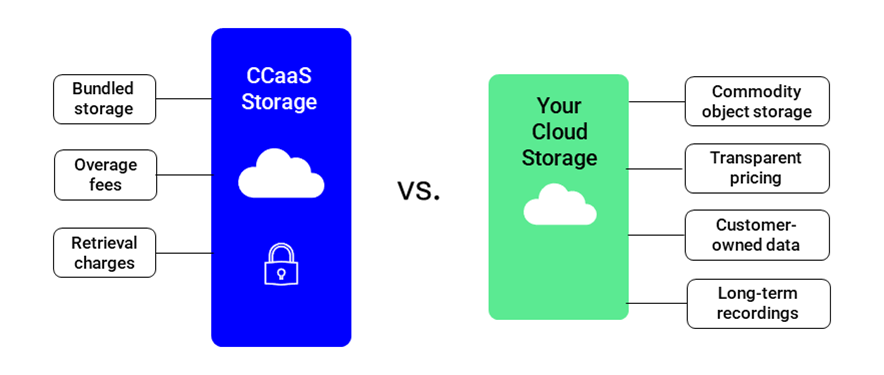
Vendors package “recording plus storage” as an all‑in platform, but the economics are driven by three levers: bundled allocations, opaque overage, and retrieval tolls.
First, for cloud recorders, you typically receive a fixed amount of storage tied to license counts and user tiers, with 12 months of retention positioned as a standard baseline. Once usage grows—more channels, higher recording percentages, screen capture, transcription—your footprint grows much faster than the included allocation.
Second, overage models are complex and rarely resemble straightforward “cents per GB per month” offered by most cloud providers. Documentation and community discussions show that keeping larger volumes of interaction data in-platform, especially beyond the default retention, generates noticeable monthly uplifts that are essentially storage fees under another name. Finally, some ecosystems introduce explicit charges when you want to move or extract data from their long‑term tiers, including per‑gigabyte fees simply to retrieve your own recordings.
The one‑year inflection point
Operationally, many organizations only need the last 6–12 months of recordings to be immediately accessible for QA workflows, coaching, and day‑to‑day dispute resolution. Past that window, recordings are retained mainly for regulatory, legal, or audit requirements, where access is infrequent, but compliance mandates span 5–7 years or more. This creates a structural mismatch: you are paying premium “application platform” rates to store largely dormant audio and screen files that behave like any other cold object storage.
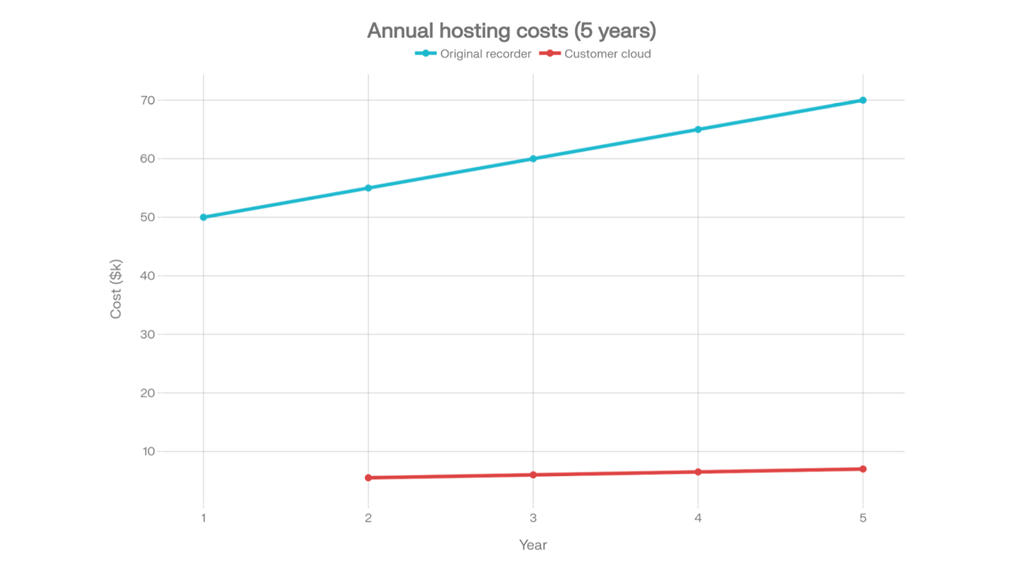
The one‑year mark is where this mismatch becomes most visible. Within the first year, additional storage often hides inside SaaS bundles, and the value of rapid search plus analytics justifies keeping everything in the native recorder. After that, the incremental business value of keeping old recordings attached to the original application often flattens, while the cost curve continues upward through capacity add‑ons, long‑term archives, and retrieval “tolls” that can exceed a dollar per gigabyte.
In contrast, your own cloud storage (as opposed to the recording vendor’s cloud storage) offers multi‑year retention at a tiny fraction of that cost, even when you factor in infrequent access tiers and egress.
Why proprietary storage persists
Despite the economics, enterprises often continue to store years’ worth of recordings inside these closed environments because moving off them is non‑trivial. Recordings are only accessible via APIs tuned for playback rather than bulk export, and bulk export may be bandwidth limited or require a special license. Compliance and audit teams also worry about chain of custody, legal hold, and evidentiary integrity if data is extracted and re‑stored elsewhere.
The result is a form of data gravity that keeps you tied to the recorder’s storage layers even when the application itself is not adding material value to older interactions. Each renewal cycle quietly bakes in another year of legacy recordings sitting on high‑cost storage, compounding total cost of ownership for what is, at its core, just voice plus metadata.
XOVOX: decoupling recording from storage
XOVOX addresses this one‑year problem by focusing specifically on the migration layer between proprietary recorders and commodity cloud storage. XOVOX connects to systems like NICE, Calabrio, and Genesys through their supported interfaces, then extracts recordings, normalizes or preserves metadata, and writes them into the customer’s chosen cloud provider and region (or even to on-premise storage) as standard objects under the customer’s direct control.
By decoupling capture from long‑term retention, XOVOX allows organizations to keep using their existing recorders for real‑time and recent interactions while moving older recordings into low‑cost, policy‑driven cloud storage classes that align with regulatory retention. Customers can then apply their own data lifecycle rules, encryption, and access controls, and they retain the option to integrate recordings with new analytics tooling without paying a recurring premium to the original recorder just to hold years of seldom‑accessed audio.
Turning the one‑year problem into a strategy
Framed correctly, the one‑year problem is not only a cost issue but a data strategy opportunity. Instead of treating voice recorders as both application and archive indefinitely, organizations can draw a clean line: the recorder owns capture and recent access; the cloud owns durable, inexpensive, long‑term retention under the customer’s governance.
With a migration service like XOVOX in place, that line can be automated: recordings age past a defined threshold (often 12 months), are exported and verified, then deleted or down‑tiered on the proprietary platform according to policy. Over time, this shifts the storage cost base from opaque, bundled recorder fees to transparent, at‑scale cloud pricing, while preserving the compliance posture and evidentiary quality that initially justified recording in the first place.
Customer service calls, 911 emergency dispatch lines, trading-floor conversations, and the recorded calls retained by banks and insurers all have one thing in common. They are often sitting on magnetic…
XOVOX is excited to be featured in the “Data Governance: the New C-Suite Priority” session at the DES 2026 conference in Malaga, Spain on June 10, 2026. Andy Stevens, XOVOX…
XOVOX is excited to be partnering with the U.S. Commercial Service, a branch of the U.S. Department of Commerce whose mission is to connect American companies with global customers. XOVOX founder…
What is the “one-year problem”? Over the past 4-5 years, the enterprise voice recorder market has evolved to a cloud-based CCaaS model instead of the traditional equipment attached to an…
Overview When large volumes of call recordings are locked away in aging or proprietary voice logging systems, organizations face a difficult mix of technical risk, operational disruption, and tight project…
Traditional voice logging systems often struggle with bulk data retrieval. These limitations can create significant operational bottlenecks, compromise compliance, and diminish the business value of your voice data recordings.
In enterprise environments such as call centers, voice recorder technology plays a critical role in ensuring regulatory compliance, maintaining service quality, and protecting both the business and the customer. Unlike…
Andrew Stevens, XOVOX Founder and CEO, is featured in a new CDOTrends article outlining how voice data is a valuable, but mostly untapped, business resource for AI training, customer service…
Business Sector Social Media Summary Extract recordings from a “voice bulletin board” implemented with Talking Technology Bigmouth software Keywords 2600, WBAI, BBS, Bigmouth The Challenge XOVOX engineers are fans of…
XOVOX, the leader in voice recording extraction and data migration, can now extract audio recordings and metadata from the Genesys PureConnect platform. With this new capability, XOVOX can help companies…